What Pixar’s Black Friday teaches about taste, AI, and the notes you say yes to.
|
Daily Creative · Episode 133
Taste Is The New Talent.
|
|
It’s November 19th, 1993, and a room full of animators is sitting in the dark, waiting for the lights to come up.
For months, the team at Pixar had been getting notes from Disney’s film chief, Jeffrey Katzenberg, and the notes kept saying the same thing: make it edgier, make it more adult, give it some bite. So they took them.
Draft after draft, they sanded off their own instincts and replaced them with someone else’s. Woody, the pull-string cowboy at the center of Toy Story, became sarcastic, insecure, and kind of a bully. He wasn’t a flawed hero anymore. He was just... kind of a jerk.
The lights came up, and the reaction was brutal. Disney shut down production, and people at Pixar still call that day Black Friday.
Disney’s Tom Schumacher said it plainly: it wasn’t their movie anymore. The team hadn’t lost its talent. It had been so busy chasing someone else’s idea of what was good that it lost track of its own.
They asked for one more shot and got two weeks. They went back to the story they had loved from the start, and two years later, Toy Story was the highest-grossing film of 1995 in the United States.
|
Options are nearly free.
Verdict is now the work. |
|
For most of human history, the hard part of creative work was production. If you wanted 50 headlines, you sat in a room and wrote 50 headlines. Today, you can get them before your coffee cools.
When something becomes nearly free, the value moves, and in this case it moves to judgment. Verdict is the ability to look at a field of possibilities and make a confident call. It’s built from taste, which is knowing what you like and why, and intuition, which is knowing before you can explain.
The tools are built to predict the most likely next thing, and probable is not the same as memorable. Let a machine render your verdict, and your work drifts toward the middle: competent, polished, and forgettable.
It isn’t only machines, either. Pixar lost its way to reasonable-sounding notes from someone powerful. The boss, the client, the committee, and the trend all make the same offer: they’ll tell you what’s good, so you don’t have to decide.
Verdict is not self-indulgence, though. “I like it” is not a strategy. A real verdict lives where two questions overlap: do I believe in this, and will it actually work?
Mike Cesario lived in that overlap when he founded Liquid Death, the heavy metal themed drinking water. At the Vans Warped Tour, he watched musicians dump out Monster Energy cans and refill them with water, and he wondered what would happen if water looked as cool as beer. Before he had a single can to sell, he put a commercial online to see if anyone cared, and it drew 3 million views. His taste told him what to make. Reality told him whether it would work.
In your week, that means writing down what good looks like before you ask any tool, or any person, for options.
Without a point of view, all you have is a menu.
|
|
So before you accept any option this week, from a tool, a boss, or a committee, ask one question:
“What would I change here, and why?” |
|
|
If you can answer, make the call. Write down your gut verdict before you look at the data, the feedback, or the tool’s recommendation, then keep track of how often you were right.
If you can’t answer, you’ve found the work. Sketch your own rough take, even if it’s ugly, and argue the options against it.
The world doesn’t need another edgy, forgettable Woody. It needs the one only you would make.
|
|
Two ways to use options
A menu
● Ask the tool for options first.
● Pick the shiniest one.
● Struggle to defend the choice.
|
A verdict
● Write what good looks like first.
● Sketch your own rough take.
● Argue each option against it.
|
Same tools, same options. The difference is whether you arrive with a point of view.
|
|
Try this today · 10 minutes
Start a verdict file
Pick one piece of work that stopped you in your tracks. Write one sentence on why it works, naming the specific choices, not “it’s beautiful.” Then write one sentence on what your current project has to accomplish and for whom. Save both in a note called your verdict file, and add to it whenever something moves you or makes you cringe. Patterns will emerge, and those patterns are your principles.
|
|
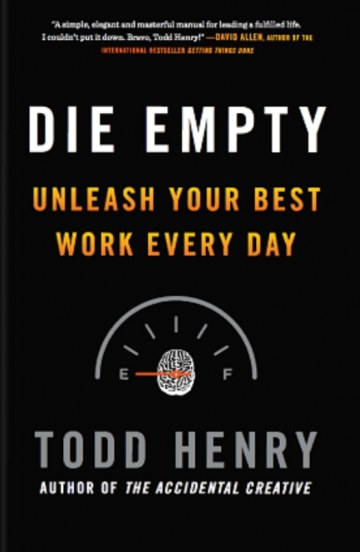 |
From Die Empty
“You will never do your best work until you learn to hone and trust your instincts, then develop the courage to take small steps in the right direction.”
Verdict grows when you trust your instincts and put weight on them, one small call at a time.
Explore Die Empty ›
|
|
|
|
This week’s Action Guide
Start your own verdict file and sharpen your taste.
The big idea, six practices, questions for you and your team, and a one-step plan for the week. It’s not what you know but what you do that matters.
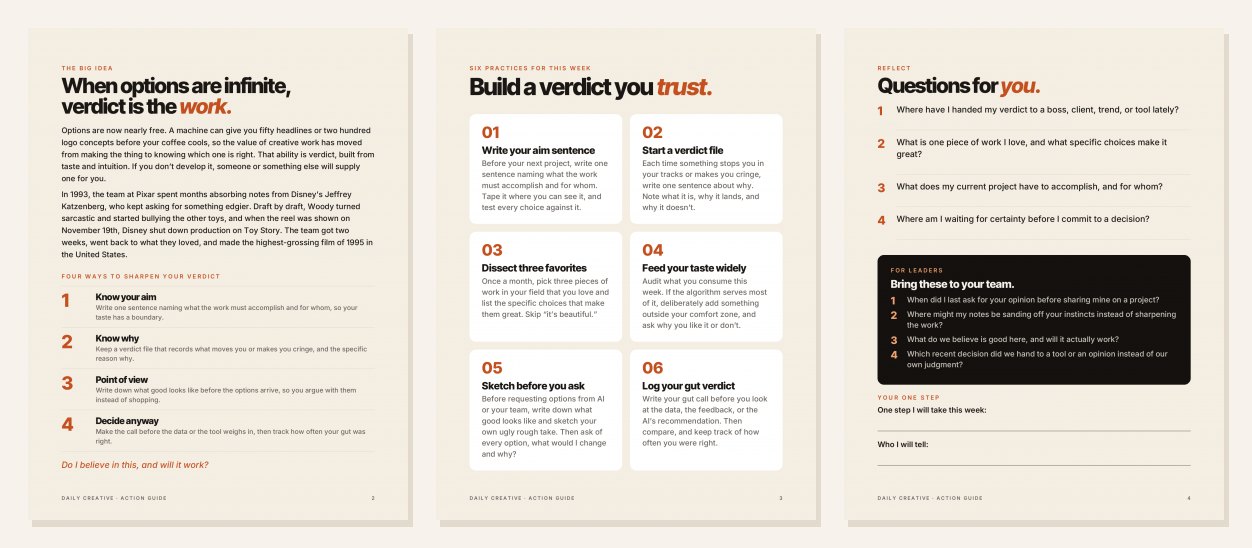 Download the Action GuideListen to the episode Also in the episode: the fourth principle of VERVE from The Infinite Lever, a Kierkegaard line about living forward, and four practices for sharpening your verdict.
|
|
For your next team meeting
Ask for verdicts before giving yours
In your next review, hold your opinion until everyone else has shared theirs. Ask each person, “What do you think is the right answer here? Why?” Then listen and ask follow-up questions. You may still make the final call, but your team will learn that bringing what they believe is the job.
|
|
|
Bring this idea to your team
The Infinite Lever
Leveraging the best of human work in the age of AI
When AI makes options nearly free, teams need people who can judge which one is right. This keynote helps leaders and audiences build the human edge that technology can’t supply.
Explore the keynote ›
|
|
|
Keep reading
|
|
Hit reply
Where have you let someone else’s verdict replace your own?
Hit reply and tell me about it. And if you know a leader drowning in AI-generated options, forward this to them.
|
Be brave, focused, and brilliant,
Todd
P.S. If you know someone who plans events or leads a team, forward this to them, because I’d love to bring these ideas to their people.
|
|
|