Flappy Bird’s creator had a hit and no recipe. Here’s how to keep your best work repeatable.
|
Daily Creative · Episode 132
Could You Do It Again?
|
|
Dong Nguyen built Flappy Bird in a few days and quietly released it into the App Store. For months, it did absolutely nothing.
Then in early 2014, it took off all at once. At its peak, the game was reportedly bringing in around $50,000 a day in advertising revenue.
When people asked him why it worked, he didn’t have an answer. He told Rolling Stone, “I couldn’t predict the success of Flappy Bird.”
The rest of the industry tried to copy it, and the clones got the surface exactly right. Almost none of them caught fire. About six months later, Nguyen’s own follow-up, Swing Copters, used the same pixel art, the same one-tap control, and even more difficulty. It never came close.
He had a massive result. What he didn’t have was a recipe. When you can’t trace the line from what you did to what happened, you can’t walk it again.
|
A result isn’t a recipe.
You can’t repeat what you can’t trace. |
|
Most of us now carry a Flappy Bird machine in our pockets. You type a request, and out comes a result. Sometimes it’s mediocre, and sometimes it’s genuinely brilliant, but very often you have no idea why it turned out the way it did.
The danger isn’t that the result is bad. The danger is that it’s good and you can’t do it again. A result you can’t trace is a lottery ticket, not a capability, and clients don’t hire you for one lucky outcome. They hire you because they trust you can deliver again when the deadline is tomorrow.
There’s a second cost. When a licensed engineer finishes the drawings for a bridge, they place their professional seal on them. That stamp says, I understand this design, I stand behind it, and if it fails, it’s on me. It doesn’t matter who drafted the lines or what software calculated the loads.
Every time you put your name on a piece of work, you apply the same stamp. “The AI did it” is quickly becoming the modern version of “the dog ate my homework.” If you ship it, you own it.
This isn’t an argument against tools. Todd uses them every day, and so should you. Delegation is fine, but abdication is not.
You can delegate the task, but you can never delegate the responsibility.
Think about your own week. Which deliverable came together fast, and which draft did you accept because it looked right? If you can’t explain the meaningful choices behind it, you made a missed deposit into your own intuition. Do that often enough and you end up with the trophies but not the muscle.
|
|
So before you ship anything this week, ask one question:
“Could I make something this good again, from a blank page?” |
|
|
If the honest answer is yes, ship it with confidence. If the answer is no, that’s not a reason to throw the work away. It’s a signal that there’s some learning to do before you move on.
Take five minutes and write down the key decisions you made, where you got stuck, and what broke through. That’s how a lucky result becomes a skill you can count on.
A bird you can’t explain is a bird you’ll never see fly again.
|
|
Try this today · 5 minutes
Start a decision trail
At the end of your next meaningful project, write one short paragraph about how it came together. Note the key decisions you made, where you got stuck, what broke through and why, and what you’d do differently next time. It doesn’t need to be elegant, and nobody will read it. Over time, it becomes a map of your own process and shows the conditions that bring out your best work.
Vague trailWent well. The first draft was strong, so I shipped it. |
Useful trailCut two directions that felt generic. Broke through when I rewrote the opening myself. |
|
|
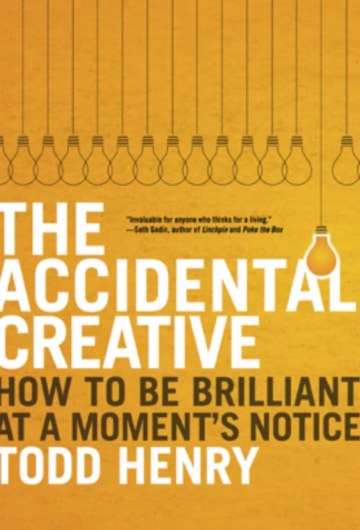 |
From The Accidental Creative
“There is no formula for effective creating and there are no shortcuts to experiencing brilliance when you need it.”
Brilliance on demand comes from understanding how you get there, not from a lucky result. Responsibility for your process is what makes it repeatable.
Explore The Accidental Creative ›
|
|
|
|
This week’s Action Guide
Make your best work repeatable instead of accidental.
The big idea, six practices, questions for you and your team, and a one-step plan for the week. It’s not what you know but what you do that matters.
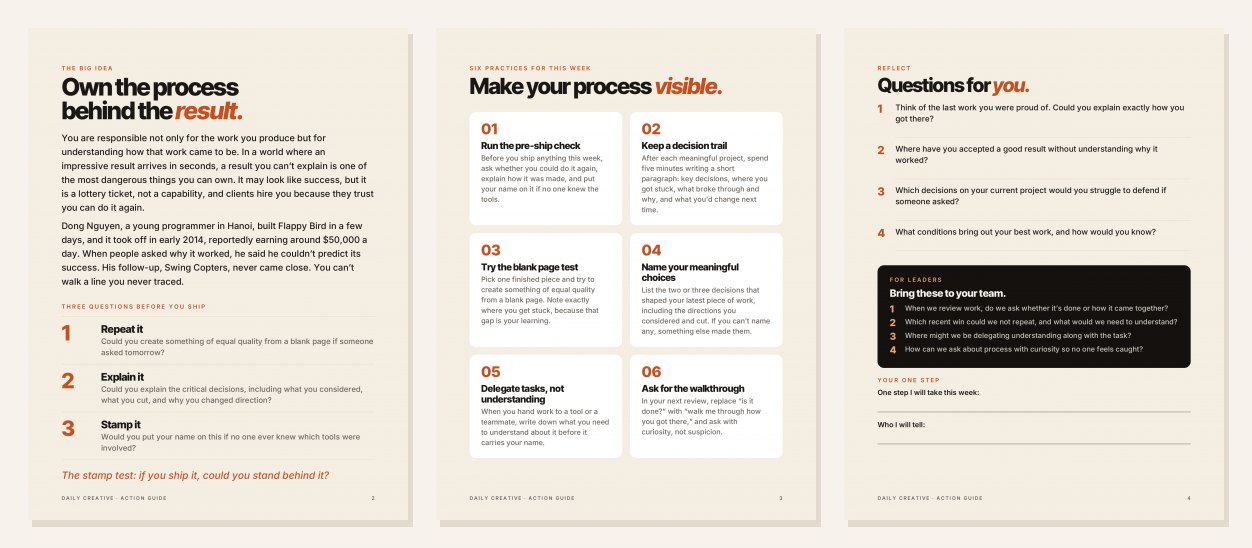 Download the Action GuideListen to the episode Todd continues his VERVE series from The Infinite Lever with the third principle, Responsibility, and previews the fourth, Verdict, for next week.
|
|
For your next team meeting
Ask “How did you get there?”
In your next review, replace “Is it done?” with “Walk me through how you got there.” Ask where the idea came from, which directions were cut, and why. Ask with curiosity, not suspicion. You’re helping your team pay attention to their own process, and that attention is what makes great work repeatable.
|
|
|
Bring this idea to your team
The Infinite Lever
Leveraging the best of human work in the age of AI
When impressive output is nearly free, teams need to own the judgment behind it. This keynote helps your people do work they can explain, defend, and repeat.
Explore the keynote ›
|
|
|
Keep reading
|
|
Hit reply
What’s one result you’ve had that you couldn’t explain?
Hit reply and tell me what you’d need to understand to do it again. And if you lead a team, forward this to someone who would ask “walk me through it.”
|
Be brave, focused, and brilliant,
Todd
P.S. If you’re planning an offsite, team event, or conference, reply and tell me about it, and we’ll talk about what your people need.
|
|
|